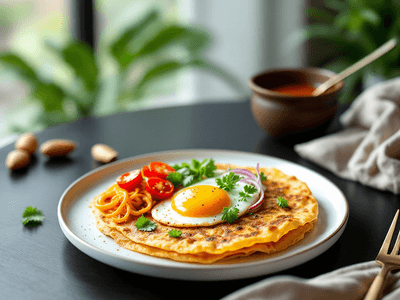
Roti Canai with Egg
Global • veg
How to Make Roti Canai with Egg (Traditional & Healthy Version)
Roti Canai with Egg, known locally as 'Roti Telur,' is a beloved Malaysian breakfast staple that reflects the country's rich multicultural heritage. This dish originated from Indian Muslim communities and has since evolved into a national favorite enjoyed by Malaysians of all backgrounds. Its irresistibly flaky texture, achieved through skillful dough handling, pairs perfectly with the richness of a soft-cooked egg, making it both comforting and satisfying. The taste is subtly savory, with a hint of sweetness from the dough and a creamy finish from the egg. Often served with dhal or mildly spiced curry, Roti Canai with Egg offers a balanced meal to start your day. Using local ingredients such as pandan for aroma and a touch of lemongrass in accompanying curries highlights Malaysia’s unique fusion of flavors. As breakfast or brunch, this dish is convenient, filling, and well-suited for those seeking a hearty start without excess fat or calories. By preparing it at home, you can control the use of oil and opt for healthy versions while still savoring the authentic taste of Malaysian street food culture.
Ingredients(for 1 Roti Canai with Egg per serving)
- 2 cups All-purpose flour (tepung gandum)
- 2 Eggs (telur ayam)
- 3/4 cup Warm water (for dough)
- 1 tsp Salt (garam)
- 1 tsp Sugar (gula)
- 2 tbsp Vegetable oil (minyak sayur)
- 2 tbsp Low-fat yogurt (substitute for ghee)
- 1 (knotted) Pandan leaf (daun pandan, optional for aroma) - optional
- 1 stalk Lemongrass (serai, optional for dough aroma) - optional
Instructions
- 1
Combine all-purpose flour, salt, sugar, and low-fat yogurt in a large bowl. Gradually add warm water and mix until a soft dough forms.
5 minutes
Knead until the dough is smooth for better flakiness.
- 2
Add 1 tbsp vegetable oil and knead for another 5 minutes. Let the dough rest, covered, for 30 minutes to relax the gluten.
5 minutes
Resting is key for a stretchy dough.
- 3
Divide the dough into 2 equal balls. Oil your hands and flatten each ball on a clean, oiled surface. Stretch gently to achieve a thin, translucent layer.
5 minutes
Use gentle, consistent pressure to avoid tearing.
- 4
Crack an egg onto the center of each stretched dough. Fold the edges over to seal and encase the egg.
2 minutes
Seal well to prevent egg leakage during cooking.
Why This Dish is Healthy
This healthier version of Roti Canai with Egg uses less oil and substitutes ghee with low-fat yogurt, cutting down on saturated fats without compromising authentic Malaysian flavor. The addition of eggs boosts protein content, supporting muscle maintenance and satiety. Made with wholesome ingredients and local aromatics, it's a nourishing breakfast option for calorie-conscious eaters.
Roti Canai with Egg provides a balance of carbohydrates, protein, and healthy fats. Eggs are rich in high-quality protein, vitamins A, D, B12, and minerals like selenium and choline. Using low-fat yogurt instead of ghee reduces saturated fat and calories. The dish also provides energy for the day and, when paired with dhal or vegetable curry, increases fiber and micronutrient intake. Choosing vegetable oil and controlling the amount helps keep the dish heart-healthy.
Pro Tips
- 💡Tip 1: Rest the dough sufficiently to ensure a stretchy, elastic texture.
- 💡Tip 2: Use a non-stick pan to minimize oil usage and keep calories low.
- 💡Tip 3: Infuse oil with pandan or lemongrass for authentic Malaysian aroma.
Storage & Serving
Store leftover roti in an airtight container in the fridge for up to 2 days. Reheat on a pan or microwave. Avoid freezing as texture may change.
Best served: Breakfast or Lunch
Nutrition Facts
| Nutrient | Per 100g |
|---|---|
| Energy | 350.0 kcal |
| Protein | 9.0 g |
| Carbohydrates | 44.0 g |
| Total Fat | 15.0 g |
| Fiber | 1.8 g |
| Sugars | 1.2 g |
| Sodium | 320.0 mg |
| Potassium | 95.0 mg |
| Cholesterol | 60.0 mg |
| Vitamin A | 90.0 IU |
| Vitamin C | 0.0 mg |
| Calcium | 35.0 mg |
| Iron | 1.6 mg |
| Magnesium | 18.0 mg |
| Zinc | 0.5 mg |
| Phosphorus | 65.0 mg |
| Vitamin D | 0.7 IU |
| Vitamin B1 (Thiamine) | 0.1 mg |
| Vitamin B2 (Riboflavin) | 0.1 mg |
| Vitamin B3 (Niacin) | 1.1 mg |
| Vitamin B6 | 0.1 mg |
| Vitamin B12 | 0.4 µg |
| Folate | 18.0 µg |